GENIUS Act: What Does it Mean for Real Estate Tokenization?


Landshare Team
.png)
The cryptocurrency industry registered a significant victory on July 18 as the US Government, under President Donald Trump, approved the GENIUS Act. This is the first law that is passed primarily to regulate the crypto industry.
Experts view this as a major win for the crypto market, as clear regulation signifies the government's acceptance of digital assets. In this article, we will learn about the provisions and the impact of the GENIUS Act, and analyze the industries that can benefit the most from this landmark decision.
What is the GENIUS Act?
The newly enacted GENIUS Act, which stands for Guiding and Establishing National Innovation for U.S. Stablecoins, marks a major milestone in U.S. crypto law. Passed by the US Congress, it establishes the first comprehensive federal framework for payment stablecoins.
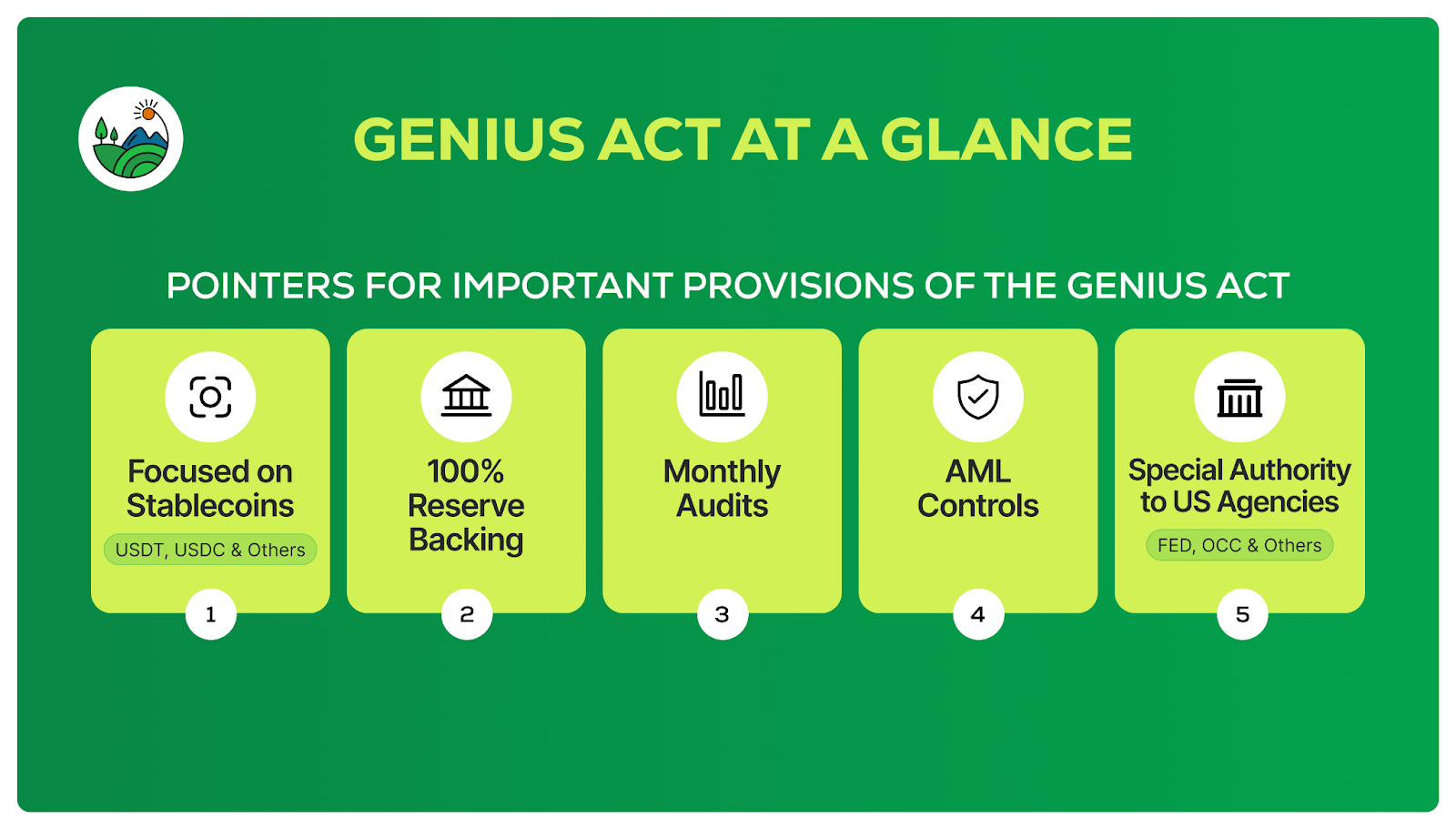
It targets stablecoins like USDT and USDC, digital dollars used on blockchains, requiring 100% reserve backing with liquid U.S. assets (dollars, Treasury bills, etc.) and strict monthly audits and public disclosures.
It sets compliance standards (anti-money-laundering programs, freezing/seizing ability on legal order), and bans misleading marketing. (no claims of being government-backed currency)
In short, the law prioritizes consumer/investor protection by requiring stablecoin issuers to follow the strict rules set by the lawmakers. As the White House notes, it “creates the first-ever Federal regulatory system for stablecoins, ensuring their stability and trust through strong reserve requirements”.
By mandating transparency and audits, the GENIUS Act effectively eliminates much of the uncertainty that had kept banks and investors on the sidelines of the crypto market.
What the GENIUS Act Does:
Sets rules for stablecoin issuers:
- Requires them to keep customer funds separate,
- Have enough liquid assets (like cash or Treasuries),
- And share monthly audit reports to prove it.
Adds safety measures against illegal activity:
- Every issuer must follow anti–money laundering (AML) and anti–terrorism guidelines.
Limits who can issue stablecoins:
- Only approved and regulated institutions are allowed to create them.
Gives power to key U.S. agencies:
- Agencies like the Department of Treasury, the Federal Reserve, the FDIC, and the Office of the Comptroller of the Currency (OCC) can now regulate and oversee stablecoins.
Protects stablecoin holders in bankruptcy:
- If an issuer collapses, customer funds are paid back first, before anything else.
So, in effect, the GENIUS Act makes stablecoins more secure and trustworthy, helping investors feel safer and giving crypto projects a stronger foundation to grow.
By defining “payment stablecoins” and assigning authority to agencies (Fed, OCC, etc.), the GENIUS Act brings clarity to how crypto dollars are treated. Under the new law, stablecoins are not securities or commodities, but a distinct asset class regulated just like bank products.
U.S. regulators will oversee major issuers, and smaller ones can operate under trusted state-chartered frameworks. This uniform approach prevents a patchwork of rules and makes sure that there is consistent compliance nationwide.
How Does the GENIUS Act Impact the Crypto Industry?
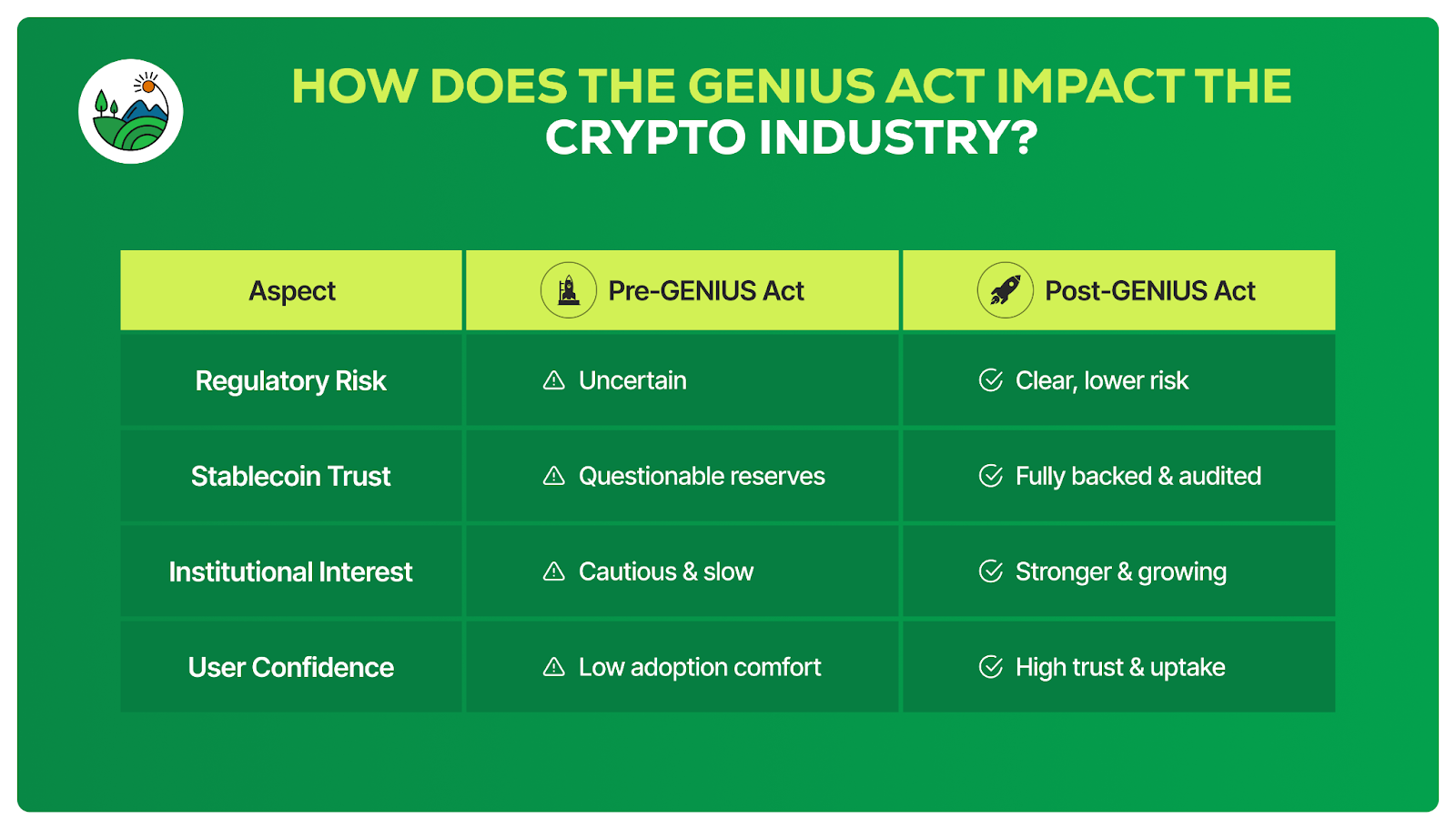
The GENIUS Act will have a major impact on the crypto industry as the Federal oversight brings a lot of trust for investors. It solves the problem of uncertainty in a market that is known for its instability.
Incidents like the FTX collapse in 2022 and the unstable market in general create a mental barrier for many against the crypto industry. However, this new law is primarily dedicated to consumer protection and stablecoin legitimacy.
Stablecoins are the key to linking tokenized real-world assets (RWAs) to traditional finance. To maintain their value, most stablecoins are linked to real-world assets, often collateralized by U.S. Treasury bonds and dollars.
For example, major coins (USDC, USDT, etc.) hold government securities to maintain their $1 peg. The GENIUS Act recognizes this, requiring exactly the kinds of high-quality backing that make stablecoins reliable.
With stablecoins firmly regulated, we can expect them to become on-chain cash for many financial processes.
How Can Tokenized Real Estate Benefit from the GENIUS Act?
One of the biggest beneficiaries of stablecoin clarity is the real estate tokenization industry. On tokenized real estate platforms like Landshare, properties are fractioned into digital tokens, allowing anyone to invest for as little as a few dollars.
The GENIUS Act’s framework tells real estate investors that the digital dollars they use (and possibly spend) on Landshare are backed and trustworthy. This reduces a key legal concern as U.S. regulators now wholeheartedly support these digital currencies, but under strict conditions.
Moreover, as stablecoins become accepted as collateral or payment on regulated platforms, the friction of buying and selling tokenized real estate further drops.
In fact, research suggests a major upswing in tokenization is on the way. Analysts cite the GENIUS Act as a turning point for RWAs. This is because the act lowers barriers and creates a fertile ground for RWA tokenization to gain mainstream attention, validating the economic potential of tokenized assets.
Moreover, real estate is an industry that has seen immense growth over the years and is one of the oldest asset classes in the world. This is due to its scarcity and the real-world value associated with it. Now that stablecoins are gaining more clarity in terms of regulation, real estate tokenization is one industry that may benefit most from it.
Why Should You Invest in Landshare Right Now?
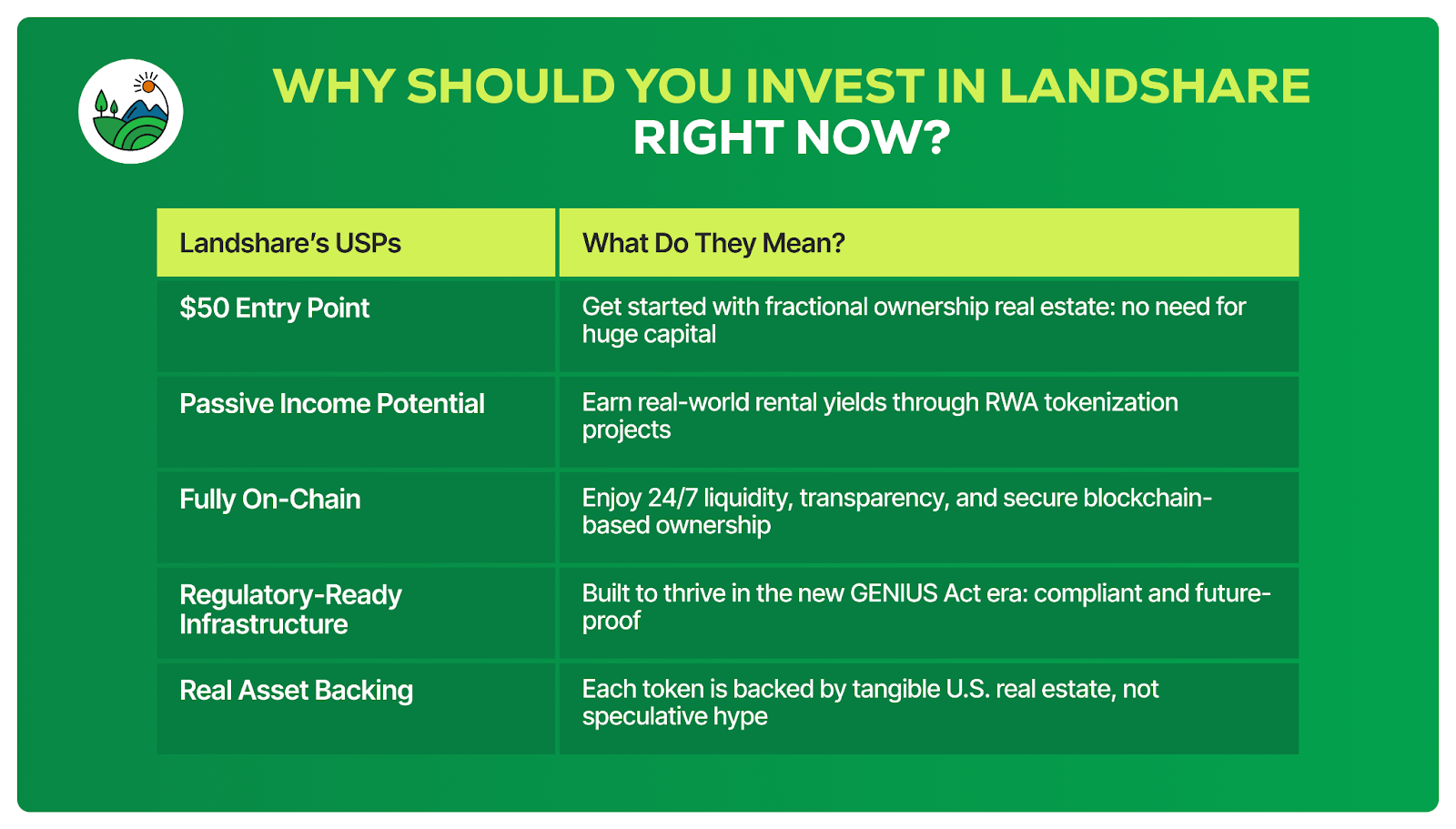
A stronger crypto framework helps Landshare’s mission of democratizing property investment. It is a U.S.-based platform that lets users own fractions of real estate on the blockchain and earn rental income and capital gains through smart contracts. Investors can start with just $50.
Unlike traditional property investments, Landshare’s model combines digital tokens (backed by real property) with DeFi features like NFT staking for extra yield. In plain terms, Landshare converts each home into a digital asset and breaks it down into several tokens that anyone can trade or hold.
The GENIUS Act’s clarity means more potential landlords, funds, and banks can join this ecosystem without fear. Moreover, property developers will have greater confidence listing projects on Landshare’s platform, and mainstream investors will know the crypto dollars they use are fully regulated.
Conclusion
A clear regulation in the crypto world was long overdue. The GENIUS Act came just at the right time for the world of digital finance. By officially sanctioning stablecoins and outlining how digital assets fit into U.S. law, the act makes way for tokenized real estate platforms to grow.
For Landshare, it means greater trust, bigger players joining the game, and confidence that the U.S. government welcomes this innovation.
Landshare October Recap
Landshare Team
October was a milestone month for Landshare – one that set the stage for the next era of on-chain real estate. From the official Landshare v2 announcement to new ecosystem updates, governance decisions, and exciting community initiatives, we’ve laid the groundwork for a future defined by growth, utility, and innovation.
This month, we introduced the framework that will redefine how investors, property owners, and DeFi users interact with real estate on-chain. Let’s recap the highlights 👇
Landshare v2 Announcement
The official unveiling of Landshare v2 signaled the start of a new chapter – one built around real utility, real yield, and real scalability.
Landshare v2 isn’t just an upgrade. It’s the foundation of a self-sustaining ecosystem where tokenized real estate finally reaches its full potential. The new system transforms stable assets into active yield-generating opportunities, seamlessly connecting traditional markets to DeFi.
The Three Pillars of Landshare v2
In our follow-up deep dive, we explored the three core pillars that form the foundation of Landshare v2:
- The Real Asset Vault (RAV): A seamless gateway for stablecoin holders to earn real yield backed by tokenized properties.
- The Tokenization Hub: A complete solution for property owners to bring their assets on-chain.
- The DeFi Suite: Tools and incentives that amplify participation and utility across the ecosystem.
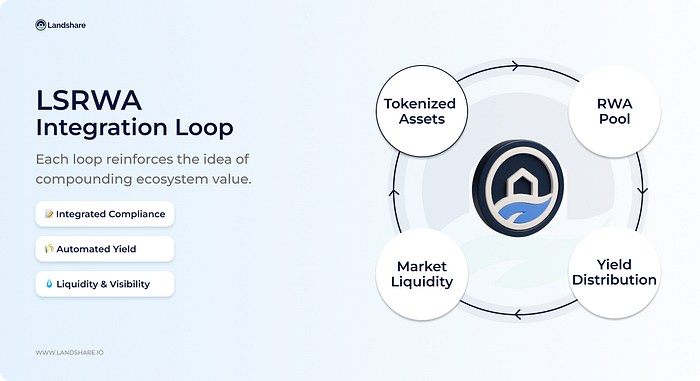
Together, these pillars create a self-sustaining growth loop, where every user and property strengthens the entire network.
DAO Proposal Passed
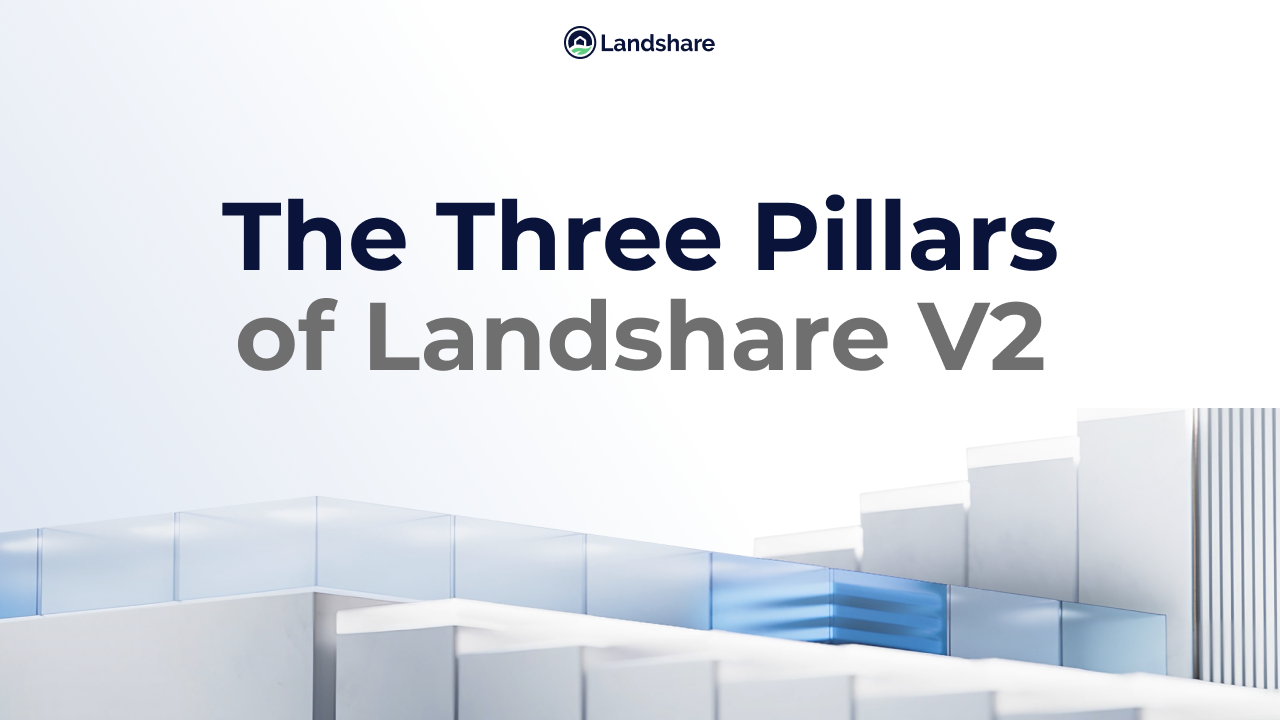
In late October, the community voted to reduce LP emissions by 50% across both the LAND–BNB and LSRWA–USDT pools – with the proposal passing at 62.28% in favor.
This important step helps:
✅ Reduce daily LAND inflation
✅ Strengthen token scarcity and price stability
✅ Extend the reward pool lifespan
✅ Encourage long-term liquidity participation
The change will take effect within 48 hours of approval and marks another move toward a more balanced, sustainable economy for Landshare v2.
🗳️ View the full proposal and results
Tokenization Hub Breakdown
We released a comprehensive guide to the Landshare Tokenization Hub, explaining how property owners can now go beyond simple tokenization to access real investors, liquidity, and on-chain utility.
The Hub bridges traditional real estate with blockchain finance – creating a pathway for real-world assets to generate ongoing yield, transparency, and accessibility.

4.5M+ LAND Staked
October also marked another key milestone – over 4.5 million LAND tokens (nearly half of the total supply) are now staked in vaults. This incredible community achievement reflects growing confidence in Landshare’s long-term vision and token utility.
Community Townhall Incoming
We’re excited to announce our next Community Townhall, happening Thursday, November 6 at 12 PM CST or 6 PM CET on X Spaces!
Join Jordan (CEO), Travis (Co-Founder), and Ivan (CMO) as they discuss everything happening with Landshare v2, recent DAO proposals, and take your questions live.

Looking Ahead
With Landshare v2 on the horizon, the foundation is set for a new phase of growth and adoption. In the coming weeks, we’ll be sharing more details on the RAV launch, the Points Campaign, and other major milestones driving our ecosystem forward.
Stay tuned – the future of real estate is being built on-chain, and we’re just getting started.
Tokenization Hub Breakdown
Landshare Team
Real estate tokenization has been a buzzword for years. Yet in practice, most projects have failed to move beyond press releases and empty promises. Too often, blockchain has been used as a veneer to package illiquid or low-quality assets, leaving investors with tokens that serve little purpose and property owners with no meaningful results.
Without investors, liquidity, or secondary markets, tokenization becomes little more than an on-chain spreadsheet — a digital record of ownership that no one can trade or invest in. For property owners, that means time and money spent “tokenizing” without achieving key goals: raising capital, expanding visibility, or unlocking value.
A Smarter Path Forward
For real estate tokenization to truly work, it needs to deliver tangible investment outcomes. After years of building and refining on-chain real estate products, Landshare has developed a model designed to do exactly that.
The Landshare Tokenization Hub transforms tokenization from a passive concept into an active investment process — connecting high-quality properties with real investors, liquidity pathways, and a live blockchain economy.
The Tokenization Hub Solution
Most platforms stop once a token is created. Landshare’s Tokenization Hub goes further , offering a complete pathway for property owners to bring their assets on-chain and immediately engage investors.
Each project is structured for success from day one, with:
- Customized tokenization models tailored to each property
- Transparent fundraising mechanics with defined soft and hard caps
- Built-in integration with the broader Landshare ecosystem
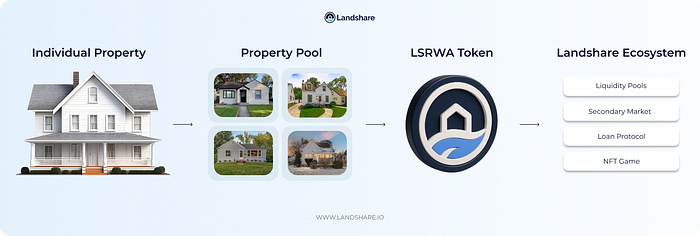
By connecting directly to Landshare’s existing network of investors and DeFi infrastructure, offerings can attract participation as soon as they launch. Once a fundraising goal is met, property tokens are deposited into the Landshare RWA Pool, linking them to ongoing liquidity, yield mechanisms, and secondary market exposure.
Why This Model Delivers Real Results
Where others leave property owners to manage marketing, compliance, and liquidity alone, the Tokenization Hub handles these as part of a unified process. This integration dramatically increases the likelihood of meeting fundraising goals and sustaining long-term engagement.
Integration with the Landshare RWA Token (LSRWA) is central to this model. Rather than isolated tokens with no market, each property becomes part of a shared, liquid environment that generates yield and investor participation. Individual assets can still be represented, extracted, or traded independently when needed.
For example, a multifamily property owner might tokenize 20% equity to raise $500,000 on-chain, connect the asset to the RWA Pool for ongoing yield, and maintain full transparency for investors — all within a compliant, accessible framework.
How It Works
- Tokenize the Property: Landshare collaborates with property owners to create a digital representation of equity, income rights, or hybrid participation.
- Launch the Offering: The property is listed on the Tokenization Hub with defined terms, caps, and transparent investor access.
- Fundraising & Validation: Investors participate directly on-chain. Once the soft cap is reached, funds are secured and the offering is finalized.
- Ecosystem Integration: Tokens are deposited into the Landshare RWA Pool, and investors receive LSRWA tokens representing pooled value and yield potential.
- Ongoing Value Creation: Property owners gain lasting benefits through liquidity, visibility, and investor engagement. As new assets are added to the pool, owners can rebalance between equity and cash, making real estate a more dynamic and liquid asset than ever before.

Built for Real-World Impact
The Landshare Tokenization Hub is more than a technical service — it’s a complete ecosystem designed to make real estate investment active, liquid, and accessible.
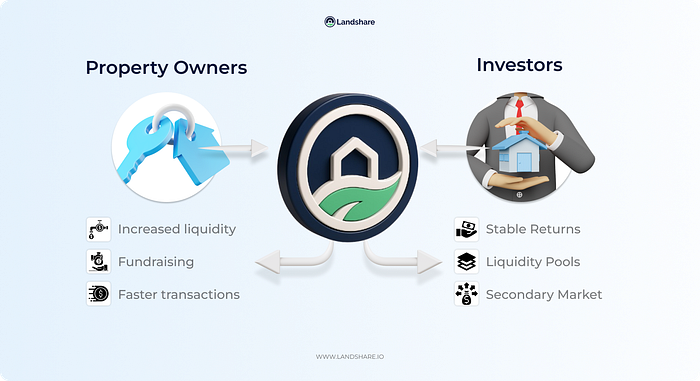
For property owners, it offers a streamlined way to raise capital and connect with global investors.
For investors, it provides exposure to yield-generating, on-chain assets backed by transparent real-world value.
In an industry crowded with static tokens and overhyped promises, the Tokenization Hub delivers what tokenization was always meant to achieve — real outcomes, real liquidity, and real-world results.
🏡 About Landshare
Landshare is a tokenized real estate ecosystem that enables seamless investment in real-world assets on the blockchain. With Landshare, you can own a share of a real-world property simply by holding our RWA Tokens ($LSRWA). Our platform offers a secure, transparent, and efficient way to invest in real estate without traditional barriers.
- Website: landshare.io
- Twitter: @Landshareio
- Community: t.me/landshare
Plume Network's SEC Approval Means RWA Projects Are Closer to the $16T Market
Landshare Team
On October 6, Plume Network announced on its social media that it had been approved to be an SEC-registered transfer agent. This is a big milestone for the RWA industry, signaling that the traditional financial system is welcoming tokenized assets.
Transfer agents basically manage important back-end work and are the official record-keepers for securities issuers. So, essentially, they maintain shareholder registries, record ownership changes, issue certificates, and handle other corporate actions.
Plume’s approval means these critical functions can now be managed on-chain for tokenized securities. This is a pretty big deal, as it gives Plume and its users formal regulatory standing under U.S. law for on-chain securities.
Experts believe that this approval can boost the global RWA market, and top players like Landshare can benefit from it due to the increased regulatory clarity.
Why is the SEC’s Approval Important for Plume Network?
So, first, understand the roles of a registered transfer agent to get a better understanding of its importance.
In traditional finance, a transfer agent is usually a company or bank that tracks who owns a company’s securities and facilitates trades. They ensure every share transfer, stock split, or dividend payment is accurately recorded and reported. Now, let’s understand how this traditional role will work in the world of blockchain.
Post Link
By replicating these roles on-chain, Plume’s platform can securely log every token sale or dividend distribution in an immutable ledger, while also syncing with regulators. As Plume explains, its transfer-agent protocol will “link cap tables and reporting directly to SEC and DTCC systems”.
This means tokenized equity and debt on Plume can behave like traditional securities, but will be managed better with the help of blockchain technology.
Plume’s CEO believes that this regulation “exists to protect investors’ rights as shareholders,” and Plume’s on-chain solution is meant to simplify the processes under that framework.
Its Impact:
Experts believe that the registration will open up several doors for the RWA market because of the ‘trust factor’. Being registered means there are no risks as far as legality is concerned. When an industry or its top player receives a green flag from the government regulatory agencies, institutional capital follows.
BlackRock, Fidelity, JP Morgan, etc., are already looking to build blockchain-based products. This will further invite them to join the RWA growth story and possibly super-boost it.
Moreover, another important benefit is that tokenized securities can now flow through compliance obstacles. This means issuance times can be cut from months to weeks with the help of smart contracts. Similarly, on-chain dividends and ICOs can enjoy the same legal protections as Wall Street offerings.
What Does This Mean For The RWA Market?
Plume’s win comes at a time when analysts are already forecasting a massive growth in tokenized RWAs over the next decade. Institutions now value tokenization as a way to digitize everything from private credit to real estate. Also, the numbers are pretty optimistic as well.
A Boston Consulting Group report estimated the global asset-tokenization market could reach about $16.1 trillion by 2030. The industry has already grown by almost 380% in the past three years. To put things into perspective, today’s entire crypto market cap is smaller than those figures. Even some of the more conservative forecasts still show multi-trillion growth.
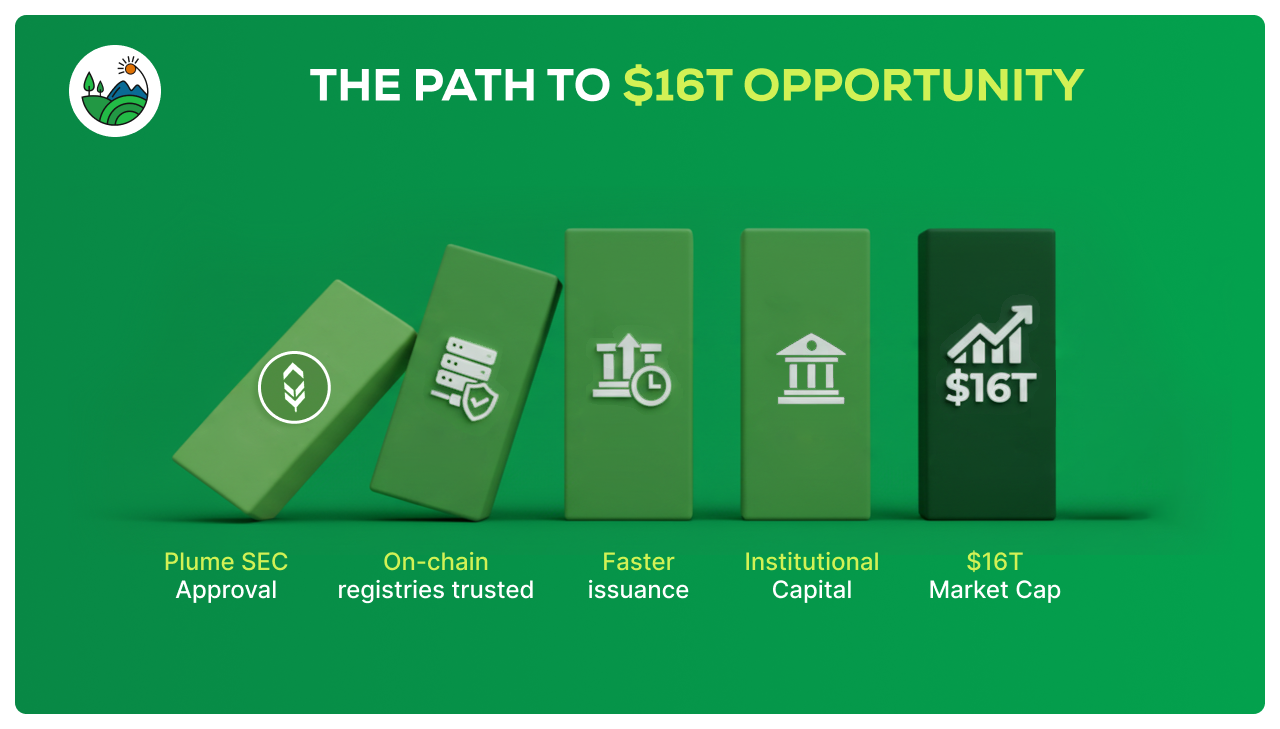
If these estimates can materialize in the days to come, RWA is well-positioned to be one of the largest markets in the world of modern finance.
Moreover, the external conditions are favoring this industry. Governments and regulators worldwide are creating proper frameworks. For instance, Asia-Pacific markets are running pilots for digital bonds and crafting standardized rules for security tokens.
These developments and the excitement of retail investors in this category build confidence that the $16T opportunity is actually very real.
How Will Landshare Benefit From This?
Landshare stands at the forefront of benefiting from this opportunity because of its early entry and real-world utility. This is very important as institutions seek new projects that have use cases that can help them capture a considerable market share.
Moreover, Landshare already operates as a compliant RWA platform. For instance, each Landshare RWA Token (LSRWA) is a security token representing fractional shares of a U.S. real estate portfolio, and buyers must pass KYC/AML checks.
The fact that regulators are now approving on-chain transfer agents shows the industry’s efforts are finally paying off. Here are some more factors that can help Landshare be one of the top RWA contenders:
1. Regulatory Credibility: Plume’s SEC status essentially means that tokenized securities can operate within established rules. Landshare’s approach aligns with these principles. So, investors can be assured that their projects sit within a legal framework designed to protect shareholders.
2. Investor Confidence: Every step toward clear regulation lifts confidence. The recently passed GENIUS Act, the SEC’s staff statements on liquid-staking, and the Trump administration’s overall outlook towards the crypto market have been fairly positive.
Similarly, Plume being approved as a SEC-registered blockchain transfer agent tells retail and institutional investors that projects like Landshare aren’t mere experiments. They’re rather a part of a regulated financial evolution.
Moreover, it means regulators see value in on-chain tokens, and that kind of signal helps legitimize the space Landshare operates in.
3. Landshare’s Own Progress: Landshare isn’t about hype. It is rather focused on delivering value from day one. The project has already sold four houses on the BNB chain. It is also providing consistent rental returns to the investors in its properties.
Moreover, the team remains focused on delivering stable, compliant returns from real estate growth.
Conclusion
So, now we know that the recent news was about more than just Plume Network being approved by the SEC to be a transfer agent. It rather has a much bigger impact on the RWA market as a whole.
While the industry continues to grow, for Landshare, it is the right time to innovate further and add more value to consumers’ lives.